
 Apple Podcasts
 Spotify
 Youtube Music
 Amazon Music
 Audible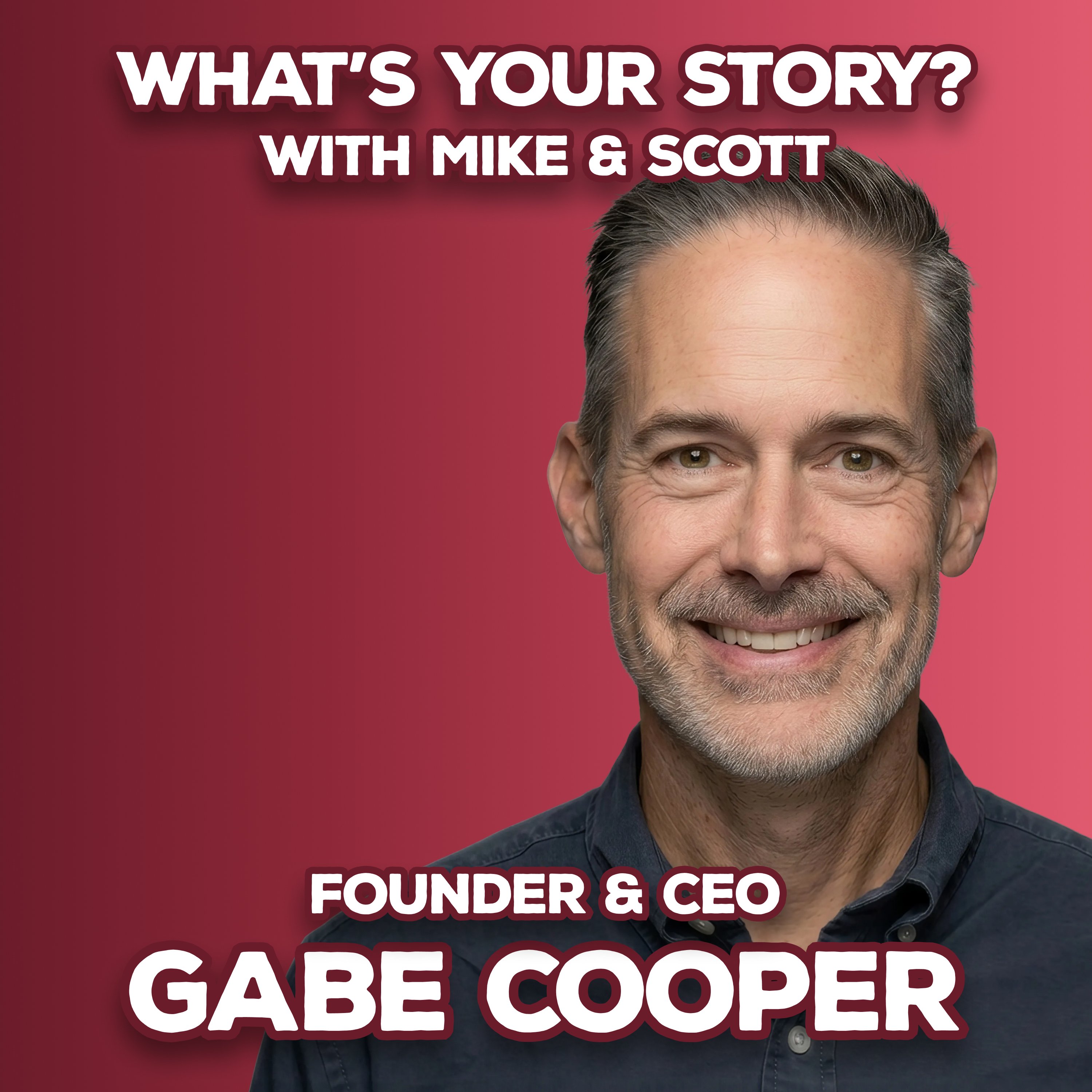
Gabe Cooper told his own son not to take a software developer job. Then he made 180 people at Virtuous build AI agents from scratch so they would not get replaced by somebody who already knows AI.
He told Mike Lindstrom and Scott Leese the line his team did not want to hear. You are not going to get replaced by AI necessarily. You are definitely going to get replaced by somebody who knows AI. If you leave because of that, you will walk into the same problem somewhere that is not as generous.
That is the tension inside this episode of What's Your Story? with Mike and Scott. Gabe is the Phoenix founder and CEO of Virtuous, the nonprofit CRM people call HubSpot for charities. Fifth straight year on the Inc. 5000. About $100 million Series C. A company mission to create $10 billion in net new generosity. Almost $2 billion of that is already live through customers.
The path there is messy on purpose. West Texas. A record label that made zero dollars. Golf Shot with Tiger Woods and Paul Azinger. Selling a consumer app company because it felt like eight seconds on a bull. Then 12 years of Virtuous, a mortgage, five kids, and the kind of endurance he now compares to a pain cave at mile 20.
He also says this is the last company. COVID. Every operating dollar in Silicon Valley Bank on the day it collapsed, found out on a pickleball court with a beer in his hand. Now AI. He is done collecting black swans.
Topics Covered
- West Texas, a high school sweetheart, five kids, and the rockstar plan that did not pay
- How you know when to pull the plug
- Why endurance beats vision, and why a mortgage creates a different kind of founder
- The chip on your shoulder, and the people who spin up when you walk away
- Why he told his son to take the construction job instead of writing code
- Anthropic Opus, Claude Code, and why “hands on the wheel” will not last
- Why Virtuous is the last company
- Silicon Valley Bank, pickleball, and the moment worrying stopped helping
- Half listening to customers, half jumping off a cliff you cannot validate
- Employee letters, faith and work, and hiring people who do not think like you
- $10 billion in net new generosity, and what “for profit” looks like in this sector
- Founder mode, 11 weekly one-on-ones, and no readout meetings
Chapters
- 00:00 Cold open: push everybody in the pool
- 00:50 Theme song
- 01:45 Welcome, and the Jeremy Beer referral
- 02:55 Gabe, what is your story?
- 03:19 Software, a dead record label, then the agency
- 04:11 Golf Shot, Tiger Woods, and getting off the bull
- 05:07 Why Virtuous exists
- 05:43 HubSpot for nonprofits, 180 people, $100M Series C
- 07:47 Andrews, Texas, Indiana Jones, and the rockstar plan
- 08:50 College, MIS, and getting a real job
- 09:47 How you know when to shut a company down
- 12:09 Marriage, mortgage, and mouths to feed
- 13:39 We do not hire people who act like a big deal
- 15:51 Don't take the software developer job
- 17:39 180 jobs and the AI problem
- 19:36 The AI Olympics
- 20:56 This is the last company
- 22:18 COVID, Silicon Valley Bank, and black swans
- 23:44 Build what they ask for, and what they cannot imagine
- 24:46 The letters from employees
- 25:36 Faith and work without an echo chamber
- 28:12 Why the CEO is a LinkedIn ghost
- 34:09 The $10 billion generosity goal
- 36:14 Rapid fire: what kids actually teach you
- 37:00 Founder mode and 11 one-on-ones
- 37:51 Closing a nonprofit deal vs a for-profit deal
- 38:26 The Emerald Mile
- 40:00 Burn out rather than rust out
- 40:54 N of 1 Philanthropy and virtuous.org
- 41:56 Outro
Episode Links
- Virtuous: https://virtuous.org
- Gabe on LinkedIn: https://www.linkedin.com/in/gabecooper
- N of 1 Philanthropy (October): search “N of 1 Philanthropy” where books are sold
If this one sat with you, send it to a founder who is staring at AI and a payroll at the same time. Then tell us in the comments. Would you tell your kid not to become a software developer right now, and why?
Thanks for watching! If this episode moved you, hit LIKE, drop a comment with your biggest takeaway, and SUBSCRIBE for more raw stories, mindset shifts, and real conversations.
New episodes drop every Tuesday morning!
- TikTok: tiktok.com/@whatsyourstorypod_com
- Instagram: instagram.com/whatsyourstorypod_com
- X: x.com/WYSPodcast_com
- Facebook: facebook.com/WhatsYourStoryPod
- LinkedIn: linkedin.com/company/whatsyourstorypod
This episode is sponsored by e3 wealth & NectarFlow. They are absolutely amazing, so please support them by checking them out today and tell them Mike & Scott sent you.
Websites
- New Show Website: whatsyourstorypod.com
- Mike's Website: mikelindstrom.com
- Scott's Website: scottleeseconsulting.com
And my people though I was crazy.
Gabe Cooper:And I'm like, "I have to push everybody in the pool, even people
Gabe Cooper:that don't wanna go in the pool."
Scott Leese:It's education by force
Scott Leese:- Gabe Cooper: Yeah.
Scott Leese:In a way.
Mike Lindstrom:I love that.
Mike Lindstrom:I love that.
Gabe Cooper:And people are like, "But I don't wanna do it and I'm not gonna
Gabe Cooper:do it." And I'm trying to explain.
Gabe Cooper:I'm like, " Look, you're not gonna get replaced by AI necessarily,
Gabe Cooper:but you're definitely gonna get replaced by somebody who knows AI.
Gabe Cooper:And if you leave Virtuous because of this, you're gonna go to work somewhere that
Gabe Cooper:you're gonna face the same problem, and they're not gonna be as generous as me.
Gabe Cooper:So
Gabe Cooper:For your own career, I need you to get in the pool because it's not
Gabe Cooper:just a Virtuous problem, it's a forever problem for your career.
Gabe Cooper:So that's how we're trying to address this, but it's, gosh, it's so much change.
Gabe Cooper:Yeah.
Gabe Cooper:It is so hard.
Gabe Cooper:Intro Band: Lean in closer. This is your time.
Gabe Cooper:Hit record on your crooked
Gabe Cooper:life. What's your story?
Gabe Cooper:(Hey!) Say the words out loud!
Gabe Cooper:Mike & Scott gonna crack that crowd.
Gabe Cooper:What's your story? (Hey!) Turn it up, let's go!
Gabe Cooper:Every voice. Every scar.
Gabe Cooper:Every road. What's your story?
Gabe Cooper:Mike and Scott.
Gabe Cooper:Let's talk.
Mike Lindstrom:Here we are, another one.
Mike Lindstrom:Mike Lindstrom, my man, Scott Leese, What's Your Story?
Mike Lindstrom:Do you remember Jeremy Beer?
Scott Leese:Yeah, of course.
Mike Lindstrom:The professor?
Scott Leese:Yes.
Scott Leese:Yeah.
Mike Lindstrom:But for Jeremy Beer, we wouldn't be here today
Mike Lindstrom:with this guest, by the way.
Scott Leese:Really?
Scott Leese:I don't think I knew that.
Mike Lindstrom:Yeah, Jeremy Beer.
Mike Lindstrom:I asked Jeremy.
Mike Lindstrom:We have lunch once a month.
Scott Leese:Got a referral.
Mike Lindstrom:Yeah.
Mike Lindstrom:So we, Jeremy and I have lunch once a month.
Mike Lindstrom:It's part of our deal.
Mike Lindstrom:And I always ask him at the very end, " Who is amazing that I
Mike Lindstrom:need to meet?" I literally asked that question just like that.
Mike Lindstrom:He goes, "I got a list." So this gentleman came up and I'm like, "Okay,
Mike Lindstrom:we gotta get ahold of each other."
Mike Lindstrom:So we've been playing tag for the last, month on this one.
Mike Lindstrom:So Phoenix based, founder, CEO.
Mike Lindstrom:You love that.
Mike Lindstrom:You gonna have to
Mike Lindstrom:- Scott Leese: I love that.
Mike Lindstrom:You're, he's a GTA actually.
Scott Leese:I, I, I already started down that angle off camera, started
Scott Leese:talking about work and stuff.
Mike Lindstrom:Okay.
Mike Lindstrom:I figured you're gonna angle it that way.
Mike Lindstrom:So anytime we get a founder or a CEO, we're gonna go down those, but
Mike Lindstrom:we're gonna get to know the story.
Mike Lindstrom:So Gabe Cooper, without further ado, Gabe Cooper did come us, come
Mike Lindstrom:through us through Jeremy Beer, who was on the show many episodes from
Mike Lindstrom:AmPhil so we're gonna get into that.
Mike Lindstrom:So as we s welcome to the show, Gabe.
Gabe Cooper:Yeah, thanks.
Mike Lindstrom:Yeah.
Mike Lindstrom:So we always start off every show.
Mike Lindstrom:You can see the name of the show right there, what's your story?
Mike Lindstrom:So we give like the abbreviated version before we start getting to all our notes.
Gabe Cooper:Yeah, yeah.
Mike Lindstrom:So take us where you want us to go.
Mike Lindstrom:So Gabe, what is your story?
Mike Lindstrom:Mr. Founder and CEO of Virtuous?
Gabe Cooper:Yeah, absolutely.
Gabe Cooper:I'll blaze through it.
Gabe Cooper:So start with personal.
Gabe Cooper:So personal thumbnail is born in West Texas.
Gabe Cooper:Moved out here to Arizona when I was a kid.
Gabe Cooper:Married my high school sweetheart and have been here ever since.
Gabe Cooper:So been with my now wife over 30 years and we have five amazing kids.
Mike Lindstrom:Wow.
Gabe Cooper:Oldest just got married.
Gabe Cooper:Youngest is like a 12-year-old girl and I am wrapped around her finger.
Gabe Cooper:But amazing.
Gabe Cooper:Professional.
Gabe Cooper:I started my career as a software developer right here in the air park
Gabe Cooper:near where we're sitting actually.
Gabe Cooper:And always had the entrepreneurial itch.
Gabe Cooper:So first company I started was actually a record label.
Gabe Cooper:Completely disconnected from software, but
Gabe Cooper:- Scott Leese: Wow, that's cool.
Gabe Cooper:Loved music and figured out that it's really
Gabe Cooper:hard to make money in music.
Gabe Cooper:So I say it was a company, but really I just lost money and didn't make any money.
Gabe Cooper:Great.
Mike Lindstrom:Passion project.
Gabe Cooper:Yeah.
Gabe Cooper:[laughing] Yeah, that's exactly right.
Gabe Cooper:And several years later started a software agency with a couple of buddies, two
Gabe Cooper:brilliant co-founders and scaled that up.
Gabe Cooper:So half of our customers were like big media companies like Red Bull or Cinemax.
Gabe Cooper:And then the other half were big nonprofits.
Gabe Cooper:And so I'll circle back to this, but my passion in life is generosity.
Gabe Cooper:And so this is really where it started is working with these amazing nonprofits,
Gabe Cooper:building custom software for them.
Gabe Cooper:Fast forward a couple years and we decided to start a mobile apps company.
Gabe Cooper:If you do the way back machine in 2008, like Apple launches their app
Gabe Cooper:store, you guys probably remember this and everything's an app
Gabe Cooper:all of a sudden out of the blue.
Gabe Cooper:And so we jumped on that train and built some mobile apps for
Gabe Cooper:sports, primarily the sport of golf.
Gabe Cooper:So first mobile app was called Golf Shot and it ended up being one of Apple
Gabe Cooper:and Google's top revenue generating apps globally for a couple of years.
Gabe Cooper:And then we followed that and partnered with Paul Azinger and Tiger Woods to do
Gabe Cooper:some instructional and golf swing analysis and then jumped into baseball and did
Gabe Cooper:an app with Jason and Jeremy Giambi, which was a hoot filming with them.
Gabe Cooper:So it's a different story for a different day, but that was great.
Gabe Cooper:Did that for a couple years and ended up selling that company.
Gabe Cooper:Realized that consumer mobile was like riding a bull at the rodeo.
Gabe Cooper:Like it's just, it's super entertaining for a minute, but then not fun.
Scott Leese:Got eight seconds and then you gotta get off.
Gabe Cooper:Exactly.
Gabe Cooper:[laughing] Yeah, that's exactly right.
Gabe Cooper:After our eight seconds, we were out.
Gabe Cooper:But following that, it kinda leads me to my company I'm at now, which is
Gabe Cooper:Virtuous, which back at my agency when I developed a love for generosity,
Gabe Cooper:I realized a couple of things.
Gabe Cooper:I realized number one, generosity has a power to change the world.
Gabe Cooper:These nonprofits are doing amazing work in the world.
Gabe Cooper:More than that, when people give their money and time to charities,
Gabe Cooper:something changes inside them.
Gabe Cooper:They get a little less selfish, a little less consumeristic,
Gabe Cooper:more focused on their neighbor.
Gabe Cooper:I though that was amazing.
Gabe Cooper:Also, these nonprofits were using horrible legacy software that was
Gabe Cooper:like a roadblock to them generating more generosity in the world.
Gabe Cooper:And I hated that.
Gabe Cooper:So started this company 12 years ago, Virtuous.
Gabe Cooper:It's, the easiest shorthand is like HubSpot for nonprofits.
Gabe Cooper:If you're familiar with HubSpot, it's like CRM and marketing and online giving,
Gabe Cooper:all of these tools to help nonprofits build more personal relationships
Gabe Cooper:with their donors effectively.
Mike Lindstrom:Gotcha.
Gabe Cooper:So have been scaling that over the last few years
Gabe Cooper:just for context and scale.
Gabe Cooper:We're at about 180 folks on the team, growing really quick.
Gabe Cooper:We just hit our fifth year in a row being on Inc's 5,000 list.
Gabe Cooper:And so continue to grow and scale really fast.
Gabe Cooper:Closed a hundred million dollar series C about two years ago, which in Arizona
Gabe Cooper:scale, that's like a decent scale, right?
Mike Lindstrom:Yeah, yeah.
Gabe Cooper:But it's just been a huge blessing.
Gabe Cooper:For me, it's a blessing because I get to do the thing I love and I'm
Gabe Cooper:passionate about generosity and my work are like the same thing every day.
Gabe Cooper:So it's just, it's magical.
Mike Lindstrom:Yeah.
Scott Leese:Wow.
Scott Leese:You mentioned generosity three or four times in the introduction.
Scott Leese:Is there, what's the person or the, the moment that really
Scott Leese:crystallized the mission for you?
Gabe Cooper:Yeah.
Gabe Cooper:I've traced that back over time.
Gabe Cooper:It's a great question.
Gabe Cooper:One is my folks.
Gabe Cooper:I have these amazing parents who are always very generous.
Gabe Cooper:We were like the house where people were always invited and
Gabe Cooper:they were always very generous.
Gabe Cooper:So I had that in my DNA early.
Scott Leese:Mm-hmm.
Gabe Cooper:But I met a couple of folks like mid-career, like late 20s
Gabe Cooper:that were just ridiculously generous.
Gabe Cooper:And I never seen anything like that.
Gabe Cooper:Oh yeah, it's not weird to give away like 90% of your money or,
Scott Leese:[laughing]
Gabe Cooper:It's not weird to drive around and just stick
Gabe Cooper:cash in people's mailboxes.
Gabe Cooper:Like that's what you do because none of it's coming with you.
Gabe Cooper:So why not
Gabe Cooper:- Scott Leese: Wow.
Gabe Cooper:…bless everybody around you in these crazy, extravagant ways?
Gabe Cooper:And I think something clicked in me at that point where I'm
Gabe Cooper:like, yeah, that's unbelievable.
Gabe Cooper:It's it seems in a world that's like super consumeristic, very polarized.
Gabe Cooper:We all seem to hate each other these days.
Scott Leese:Yeah, sure.
Gabe Cooper:Like generosity seems to be the antidote to so much of what's
Gabe Cooper:got people wrapped around the axle.
Scott Leese:Yeah.
Scott Leese:Generosity, compassion, empathy.
Scott Leese:And that's, it's unique in the entrepreneurial world.
Scott Leese:Yeah.
Scott Leese:These are terms that don't get thrown around very often
Scott Leese:- Gabe Cooper: Yeah.
Scott Leese:In my experience.
Mike Lindstrom:They're antonyms, not synonyms.
Scott Leese:Yeah.
Scott Leese:Yeah.
Scott Leese:Yeah.
Scott Leese:In tech.
Scott Leese:For sure.
Mike Lindstrom:That's a big one.
Mike Lindstrom:So what was the, what about growing up?
Mike Lindstrom:When you, what'd you wanna when you grew up?
Mike Lindstrom:Take us a little bit back.
Mike Lindstrom:'Cause we like to go back to, we like to go back to like what influences, but you
Mike Lindstrom:had those things in your mind - Yeah.
Mike Lindstrom:What you envisioned as a child.
Mike Lindstrom:What were some of those?
Gabe Cooper:Yeah.
Gabe Cooper:It's like any kid.
Gabe Cooper:It's all over the map.
Gabe Cooper:The town I was born in West Texas is called Andrews.
Gabe Cooper:It's outside of Odessa.
Gabe Cooper:So if you've seen like Landman or Friday Night Lights, like that's where I grew up.
Gabe Cooper:And the imagination for like what's out there in the world, it's like you, there's
Gabe Cooper:no imagination for that kind of stuff.
Gabe Cooper:So as a kid, I, I saw Indiana Jones and I wanted to be an archeologist,
Gabe Cooper:[laughing] It's that kind of thing.
Gabe Cooper:I think, once I got into high school, I was good in math and
Gabe Cooper:science and knew probably that's my career would end up there.
Gabe Cooper:But in the back of my head, I though I could also be a rockstar,
Gabe Cooper:I could play music for a living and
Gabe Cooper:- Mike Lindstrom: Do you have a, do you play an instrument?
Gabe Cooper:Yeah.
Gabe Cooper:I played in bands for years and I'm not terribly good.
Gabe Cooper:And it's really hard to make money at that.
Gabe Cooper:So it's a bad combo.
Gabe Cooper:But those were, yeah, somewhere between archeologist and rock star, just I
Gabe Cooper:think, but I think those are probably
Gabe Cooper:- Mike Lindstrom: Yeah.
Gabe Cooper:If you were to survey 100 men my age, that's probably
Gabe Cooper:number one and two on the list.
Mike Lindstrom:Yeah.
Mike Lindstrom:But when you graduate college, now fast-forward, now you're graduating
Mike Lindstrom:college, st- stuff's getting real.
Mike Lindstrom:You're like - It's getting real.
Mike Lindstrom:Okay now what?
Gabe Cooper:Yeah.
Mike Lindstrom:What were you thinking at that point?
Gabe Cooper:Yeah.
Mike Lindstrom:So - What am I gonna do?
Gabe Cooper:Probably a couple things.
Gabe Cooper:At that point, I was already dating my wife and she's so sweet.
Gabe Cooper:But she's also seeing me do music and wanting to be
Gabe Cooper:Indiana Jones and a rockstar.
Gabe Cooper:And she's like, " You could have a job too, right?
Gabe Cooper:Because we're gonna get married." So my major was MIS, and I realized
Gabe Cooper:I love computers and there was a job for computers in the world.
Gabe Cooper:And so I started working as a software developer just because it's a way
Gabe Cooper:to have a job and pay the mortgage.
Gabe Cooper:What I learned though is a couple things.
Gabe Cooper:Number one, I loved building software.
Gabe Cooper:I love building stuff.
Gabe Cooper:I didn't realize it at the time, but it's a passion.
Gabe Cooper:And I loved entrepreneurship.
Gabe Cooper:Like I loved being able to create something and build something on my own.
Gabe Cooper:And at the time, if you think that was like the first dot com boom and bust.
Gabe Cooper:And so there was this thing in the air where if you knew how to build software,
Gabe Cooper:you could make something and make a living out of it and that was like in
Gabe Cooper:all of our imagination at the time.
Mike Lindstrom:Yeah.
Scott Leese:You mentioned that your first company the record label, you shut down.
Gabe Cooper:Yeah.
Scott Leese:So there's, I'm gonna screw the quote up, but there's a quote about
Scott Leese:entrepreneurship that's like most people make it because they just never quit.
Gabe Cooper:Yeah.
Scott Leese:Everybody has had all these moments where like I should quit or I'm,
Scott Leese:I wonder if I should quit or whatever.
Scott Leese:All these second guessing
Scott Leese:- Gabe Cooper: Oh my gosh.
Scott Leese:…moments and all this kind of stuff.
Scott Leese:How do you actually know when to pull the trigger and be like, "This
Scott Leese:isn't it." You didn't shut down your entrepreneurial journey, but you're
Scott Leese:like, "This company, this is not it."
Scott Leese:Yeah.
Scott Leese:How do you decide, decipher between am I just quitting?
Scott Leese:Should I press on?
Scott Leese:Versus no, now is the time like to pull the plug?
Gabe Cooper:Yeah.
Gabe Cooper:Let me start with the first part of what you said, which is the endurance part.
Scott Leese:Yeah.
Gabe Cooper:I think that is the number one quality of a great entrepreneur.
Gabe Cooper:It's not, are you a visionary?
Gabe Cooper:Are you inspirational?
Gabe Cooper:Are you smart?
Gabe Cooper:I don't even think it's like, do you have an end market that will support this?
Gabe Cooper:I think the biggest thing is like you just don't quit.
Scott Leese:Yeah.
Gabe Cooper:Like I got into in my mid - 40s, my midlife crisis
Gabe Cooper:was like starting to do endurance sports, so running a long way.
Gabe Cooper:And that's the best thing I've ever had to equate to the entrepreneurial journey
Gabe Cooper:is like you've run 20 miles, you're in the middle of the mountain somewhere,
Gabe Cooper:everything in you just says quit, right?
Gabe Cooper:But then you just keep putting one foot in front of the other for
Gabe Cooper:no other reason than can I do it?
Scott Leese:Yeah.
Gabe Cooper:Just in the pain cave.
Gabe Cooper:Like that is entrepreneurship.
Gabe Cooper:So I, all of my other businesses have been successful, not because I'm terribly
Gabe Cooper:smart or I had a terribly good idea.
Gabe Cooper:It's just because I didn't quit, really.
Gabe Cooper:That one is like, it was so painfully obvious.
Gabe Cooper:Like I'm using all of my money to do stuff and then I'm looking at the stuff I'm
Gabe Cooper:producing and it is making zero dollars and it objectively sucks [laughing]
Gabe Cooper:compared to everything else out there.
Gabe Cooper:[laughing] I'm like, and I'm like, there's no light at the end of the tunnel.
Gabe Cooper:Like I can't even see a glimmer of anything.
Gabe Cooper:And I think in those moments, yeah, you gotta
Gabe Cooper:- Scott Leese: So would you tell somebody that could still see a light at the
Gabe Cooper:end of the tunnel or a glimmer, as long as you can see that light, press on?
Gabe Cooper:I would… ah, yeah.
Gabe Cooper:I, I would say press on way further than you think you can.
Gabe Cooper:When everything tells you to stop, like
Gabe Cooper:- Scott Leese: Yeah.
Gabe Cooper:It's probably still a couple miles past that.
Scott Leese:Yeah.
Gabe Cooper:And so it has to be uncomfortable.
Gabe Cooper:And that's what.
Gabe Cooper:And most en - you talk to most great entrepreneurs and
Gabe Cooper:there's story after story of
Gabe Cooper:- Scott Leese: Yeah.
Gabe Cooper:It should've failed 20 times and I just kept showing up.
Scott Leese:Yeah.
Scott Leese:Yeah.
Mike Lindstrom:You said something important there.
Mike Lindstrom:You said, "All of my money," and I was getting no.
Mike Lindstrom:So it's one thing when you put your money in and you start to see people getting
Mike Lindstrom:excited and it's other people's money.
Mike Lindstrom:But that's a big jump off when I know for me, it's my wife.
Gabe Cooper:Yeah.
Mike Lindstrom:She's like, a lot of our money is going into this.
Gabe Cooper:Yes.
Mike Lindstrom:Where's the return?
Mike Lindstrom:So how much does the, your college sweetheart weigh into
Mike Lindstrom:some of your business decisions when it comes to those times?
Gabe Cooper:It's huge.
Gabe Cooper:I do think I'm fortunate to be married to somebody that will put up with
Gabe Cooper:this kind of entrepreneurial behavior, but it's also a great counterbalance
Gabe Cooper:to be more disciplined, right?
Gabe Cooper:So probably a better example is when we started our software development agency,
Gabe Cooper:I was working at a normal job during the day, and then nights and weekends,
Gabe Cooper:I was trying to build out this agency.
Gabe Cooper:Well, I had a, I think we had two kids at the time, and a mortgage.
Gabe Cooper:And my wife had quit to stay home with the kids.
Mike Lindstrom:Wow.
Gabe Cooper:And that creates, like… and there's no venture
Gabe Cooper:capital to start an agency.
Gabe Cooper:You just gotta, pull yourself up by your bootstraps, right?
Gabe Cooper:And so I do think something about the, the constraints of that.
Gabe Cooper:And then honestly, being married to somebody and having a mortgage is as
Gabe Cooper:bad as it sounds, it creates constraints and in a level of endurance and
Gabe Cooper:effort that sometimes you don't see.
Gabe Cooper:I've met folks in Silicon Valley that, get a startup funded,
Gabe Cooper:pre-product, pre-revenue.
Gabe Cooper:Somebody gives them a check for a couple million dollars and they're not
Gabe Cooper:married and they don't have kids, and they know if they run this thing into
Gabe Cooper:the ground, they can just do it again.
Scott Leese:Yeah.
Gabe Cooper:And there's a different level of intensity and
Gabe Cooper:focus when you got mouths to feed,
Scott Leese:It's a different level of accountability
Scott Leese:- Gabe Cooper: Yes.
Scott Leese:I think.
Mike Lindstrom:Yeah.
Mike Lindstrom:Who do you.
Mike Lindstrom:I've said that as a coach.
Mike Lindstrom:The.
Mike Lindstrom:See, people ask me what's the most difficult person to work with?
Mike Lindstrom:And I see young people with no purpose, no marriage, no kids, no mortgage.
Gabe Cooper:Yeah.
Mike Lindstrom:What about you?
Mike Lindstrom:When you're doing, in business, who is really difficult for you?
Mike Lindstrom:What's that challenging individual person for you on the other side?
Mike Lindstrom:- Or even in, within your company?
Gabe Cooper:Yeah.
Gabe Cooper:I one of our values at Virtuous is we don't hire anybody who's a big deal.
Gabe Cooper:And people will say, it seems like you have a lot of smart people working here.
Gabe Cooper:They're a big deal." And I'm like, "Yeah, but they don't act like a big deal."
Gabe Cooper:And I think probably all of us have had to work with people at some point
Gabe Cooper:in our career that think they're a big deal and act like they're a big deal.
Gabe Cooper:For me, that is the one thing, like walking into a room, assuming you're
Gabe Cooper:right, assuming you're better, assuming people need to wait on your hand and foot.
Gabe Cooper:That is the one thing that I just do not tolerate.
Gabe Cooper:I'll tolerate a bunch of other stuff, but that one's hard for me.
Mike Lindstrom:Yeah.
Mike Lindstrom:Any other pet peeves outside of that, in- inside of your company or in business?
Gabe Cooper:I think there's this.
Gabe Cooper:And you both have probably seen this before, but there's probably two
Gabe Cooper:binary, but maybe two kinds of people.
Gabe Cooper:One is you give them instruction, and you walk away, and they start rolling,
Gabe Cooper:and they start rolling faster and faster.
Gabe Cooper:They're spinning up more and more.
Gabe Cooper:They're thinking about everything.
Gabe Cooper:And you come back a week later and you realize they've been working 70
Gabe Cooper:hours a week deep in this thing because they're committed to getting it done.
Gabe Cooper:There's another person that you can come tell the same thing to, and
Gabe Cooper:they're a little bit passionate when you're there, but they spin down, down,
Gabe Cooper:they start watching YouTube videos.
Gabe Cooper:[laughing] you come back a week later, and they're like, "Yeah, I don't know."
Gabe Cooper:It's like And I'm always looking for.
Gabe Cooper:I call it, the chip on your shoulder.
Gabe Cooper:Mm-hmm.
Gabe Cooper:Who has a chip on their shoulder?
Mike Lindstrom:Yeah.
Gabe Cooper:Something to prove, and so when you walk away, their ramp
Gabe Cooper:rate is up and not down, right?
Gabe Cooper:And we're always trying to hire that.
Gabe Cooper:I don't quite know how to interview for it yet.
Gabe Cooper:Yeah.
Gabe Cooper:I know it when I see it, after 30 days, but yeah.
Mike Lindstrom:Chip on a shoulder.
Mike Lindstrom:Sound familiar?
Scott Leese:Yeah.
Mike Lindstrom:[laughing]
Scott Leese:I've always had a chip on my shoulder.
Scott Leese:In,
Mike Lindstrom:[laughing]
Scott Leese:In, in fact, one of the ways that I would try to screen for that in
Scott Leese:interviews is I'd ask people, "What's the hardest thing that you've been through or
Scott Leese:give me some moment that you got passed over where you should have got something
Scott Leese:you deserved and you didn't get it?
Scott Leese:Like, how did you respond?
Scott Leese:What.
Scott Leese:How do you think about it?
Scott Leese:Does it still bother you?
Scott Leese:Tell me a time from 20 years ago that you're still thinking of that
Scott Leese:you got skipped and still pisses you off." Question, questions like that.
Gabe Cooper:That's a great question.
Scott Leese:I was thinking about your decision to study MIS - and
Scott Leese:that you're a software developer.
Scott Leese:And I know you have kids.
Scott Leese:I have.
Scott Leese:My oldest is leaving to go to university in a couple weeks.
Scott Leese:That's great.
Scott Leese:My youngest is a rising junior.
Scott Leese:And my brother is a software developer.
Scott Leese:And my kids were, they're always like "What should I study?" And my brother is
Scott Leese:like, "Don't study software engineering."
Gabe Cooper:Yes.
Scott Leese:Don't go get a computer science major." Agree or disagree?
Gabe Cooper:Agree.
Gabe Cooper:I. In fact, I agree so much.
Gabe Cooper:My oldest son could have chosen recently between working at Sunt Construction
Gabe Cooper:and big construction company or taking a job as a software developer.
Gabe Cooper:He called me and asked, I'm like, "Don't take a job as a software developer.
Gabe Cooper:Go to work at the
Gabe Cooper:- Scott Leese: Tell everybody why.
Gabe Cooper:Why is a software development job not necessarily the smartest thing right now?
Gabe Cooper:It's.
Gabe Cooper:In November, there's a. Anthropic launched Opus
Gabe Cooper:- Scott Leese: Yep.
Gabe Cooper:In November.
Gabe Cooper:It completely changed how we build the digital products fundamentally.
Gabe Cooper:It was already changing, but that was, like, the seminal moment for most
Gabe Cooper:people, which means, the idea of being a software developer or a designer
Gabe Cooper:or a product manager, kind of the trifecta you would have in any team,
Gabe Cooper:all of those got reduced to, zero.
Gabe Cooper:Anybody can write code now.
Scott Leese:Yeah.
Gabe Cooper:And people say," you still need a good software developer
Gabe Cooper:with their hands on the steering wheel. "That's kind of true, but
Gabe Cooper:you don't need as many of them.
Gabe Cooper:And AI is as bad today as it will ever be.
Scott Leese:Mm-hmm.
Gabe Cooper:And six months from now, you probably don't need somebody
Gabe Cooper:with their hands on the wheel anymore
Gabe Cooper:- Mike Lindstrom: Yeah.
Gabe Cooper:The same way you did.
Scott Leese:Yeah.
Gabe Cooper:Which has put the whole industry, on its head.
Gabe Cooper:And if you're going into the industry now, you gotta know that your job will change
Gabe Cooper:probably 10 times in the next two years.
Gabe Cooper:And your only skills will be, are you really smart and will you outwork people?
Gabe Cooper:Are you incredibly curious?
Gabe Cooper:Are you a good people person?
Gabe Cooper:Do you have taste?
Gabe Cooper:It's these, first principle kind of things that will make you successful.
Gabe Cooper:It's no longer about, do I know how to code?
Gabe Cooper:It's, very secondary.
Scott Leese:Do you feel the burden of responsibility of having a
Scott Leese:team of nearly 200 and watching software developers and AI just
Scott Leese:gobble up all these different roles?
Gabe Cooper:Yes.
Scott Leese:And you watch these other companies, XYZ
Scott Leese:company lays off 30,000 people.
Gabe Cooper:Yes.
Scott Leese:It's like, do you feel the responsibility of I have
Scott Leese:200 people employed underneath me, and every day, I'm watching one or
Scott Leese:two of them's role maybe start to be less necessary, let's just say.
Gabe Cooper:Yeah.
Scott Leese:And what am I supposed to do with that?
Scott Leese:Should I just lay everybody off because that's in the
Scott Leese:best interest of the company?
Scott Leese:Or no, these are people that have helped me get here.
Scott Leese:How do I redeploy them as a resource into the company?
Scott Leese:What is.
Scott Leese:I know CEOs - the ones that are generous, compassionate, have
Scott Leese:empathy, they're thinking about that.
Scott Leese:The ones that don't have those characteristics are just, slash
Scott Leese:30,000 of you gone, profits went up.
Gabe Cooper:Yeah.
Mike Lindstrom:Send out an email in the morning.
Scott Leese:Yeah.
Scott Leese:Yeah.
Mike Lindstrom:No communication.
Scott Leese:Yeah, 30,000 people fired, not even over Zoom, over email.
Gabe Cooper:Yes.
Scott Leese:So h- how do you reconcile that burden of responsibility?
Scott Leese:That terrifies me as an entrepreneur.
Gabe Cooper:Oh, it's horrible.
Gabe Cooper:It's a huge moral dilemma because I have, a sort of a fiscal responsibility
Gabe Cooper:- Scott Leese: Yeah.
Gabe Cooper:To my investors, but I have a responsibility to my customers.
Gabe Cooper:These nonprofits that I serve deserve the best.
Gabe Cooper:And so they're trusting me to deliver the best.
Gabe Cooper:My investors are trusting me to deliver outsized returns, right?
Gabe Cooper:And so I have to marry that with, I have, the people that work for me I've
Gabe Cooper:been friends with a decade, right?
Gabe Cooper:It's horrible.
Scott Leese:Yeah.
Gabe Cooper:Now, there's a couple of things.
Gabe Cooper:Number one, sometimes you do just have to make that decision.
Gabe Cooper:There's no way around to making that decision.
Gabe Cooper:The couple of sort of maxims that have been helpful for me is if you get your
Gabe Cooper:team, your current team, let's say my 180 folks, if you can get every one of
Gabe Cooper:those people operating with the power of three to five X their current powers,
Gabe Cooper:then I don't have to lay them off.
Gabe Cooper:Now all of a sudden, I have the power of a 300-person company, a 500 person company.
Gabe Cooper:Yeah.
Gabe Cooper:So I'm not increasing headcount, but if I can supercharge all of
Gabe Cooper:them, so what does that mean?
Gabe Cooper:For us, it meant we ran an AI Olympics so I made everybody on my
Gabe Cooper:team build an AI agent from scratch
Gabe Cooper:- Scott Leese: That's great.
Gabe Cooper:Or build an application with Claude Code.
Scott Leese:Yeah.
Gabe Cooper:And my people though I was crazy.
Gabe Cooper:And I'm like, "I have to push everybody in the pool, even people
Gabe Cooper:that don't wanna go in the pool."
Scott Leese:It's education by force
Scott Leese:- Gabe Cooper: Yeah.
Scott Leese:In a way.
Mike Lindstrom:I love that.
Mike Lindstrom:I love that.
Gabe Cooper:And people are like, "But I don't wanna do it and I'm not gonna
Gabe Cooper:do it." And I'm trying to explain.
Gabe Cooper:I'm like, " Look, you're not gonna get replaced by AI necessarily,
Gabe Cooper:but you're definitely gonna get replaced by somebody who knows AI.
Gabe Cooper:And if you leave Virtuous because of this, you're gonna go to work somewhere that
Gabe Cooper:you're gonna face the same problem, and they're not gonna be as generous as me.
Scott Leese:Yeah.
Gabe Cooper:For your own career, I need you to get in the pool because
Gabe Cooper:it's not just a Virtuous problem, it's a forever problem for your career, right?
Gabe Cooper:So that's how we're trying to address this, but it's, gosh, it's so much change.
Gabe Cooper:Yeah.
Gabe Cooper:It is so hard.
Mike Lindstrom:It's a great idea.
Mike Lindstrom:I love that idea.
Scott Leese:Yeah.
Mike Lindstrom:I'm gonna take that one, give that to my clients.
Mike Lindstrom:No, seriously.
Mike Lindstrom:That's a great tool.
Gabe Cooper:It's amazing.
Gabe Cooper:We have a, whatever, 170 AI agents running wild across our organization right now.
Mike Lindstrom:So who won?
Gabe Cooper:And
Mike Lindstrom:You don't need to name the name, but what was the thing that won?
Gabe Cooper:Oh yeah.
Gabe Cooper:So we put up bounties, prizes, gave like five grand, three grand, like
Gabe Cooper:cash for like winners, had them judged by the executive team, gave all these
Gabe Cooper:like one-off prizes for creativity, put real cash on the line, had a big thing.
Mike Lindstrom:Talk about a spiff!
Gabe Cooper:It was so much fun.
Scott Leese:Yeah, it's a big spit.
Mike Lindstrom:It's a big spit.
Scott Leese:I hope I don't get this wrong, but I think I read that you
Scott Leese:said this will be your last company.
Gabe Cooper:100%.
Scott Leese:Or last company or last startup.
Scott Leese:I can't remember how you phrased it.
Gabe Cooper:100%.
Scott Leese:Is.
Scott Leese:Okay, so I got the quote right.
Scott Leese:So is this stuff that we're talking about, the burden of
Scott Leese:that part of the reason for that?
Scott Leese:Or is it just, "No, I've done this a few times and I wanna spend the
Scott Leese:rest of my days doing other things."
Gabe Cooper:Yeah.
Scott Leese:There's - 'Cause most entrepreneurs have a
Scott Leese:hard time shutting off the entrepreneurial part of their brain,
Gabe Cooper:There's a couple of reasons, and I think, for people
Gabe Cooper:that have been entrepreneurs, you'll resonate with some of them.
Gabe Cooper:One is that the thing I'm doing now aligns my purpose in life with
Gabe Cooper:the thing I get to do for a living.
Gabe Cooper:There's only very few people in the world that get to do something like that.
Gabe Cooper:Yeah.
Gabe Cooper:Anything I do after this will be less than that, right?
Gabe Cooper:So that.
Gabe Cooper:Number two, it takes.
Gabe Cooper:It always takes longer and costs more to build a business than you think.
Gabe Cooper:I'm 50 years old.
Gabe Cooper:You give your blood for a decade
Gabe Cooper:- Scott Leese: Yeah.
Gabe Cooper:…to build something great, at least, right?
Gabe Cooper:And, I would have to go into that eyes wide open, building
Gabe Cooper:something from new, from scratch.
Gabe Cooper:As you get older, your brain just gets less plastic.
Gabe Cooper:I have a lot of scar tissue and muscle memory pattern recognition, wisdom.
Gabe Cooper:But my brain isn't as quick as it was when I was 25.
Gabe Cooper:It's just not, right?
Gabe Cooper:But the, the last one is the thing you said, which is, so I was talking to a
Gabe Cooper:guy yesterday, he's like, "I would love to live in precedented times." And I'm
Gabe Cooper:like, "Yeah, I could stand to live in a. For a few years of precedented times."
Gabe Cooper:And I think this is, as a business, we've now gone through COVID.
Gabe Cooper:I had all of my money in Silicon Valley Bank when that collapsed.
Gabe Cooper:That was a horrible day playing pickleball and all my money went away.
Gabe Cooper:We went through.
Gabe Cooper:It's just been, like, one thing after another, and now AI
Gabe Cooper:completely reshapes the industry.
Gabe Cooper:I built the business in 2008 during that financial crisis.
Gabe Cooper:Yeah.
Gabe Cooper:I was in.
Gabe Cooper:And when the dot com boom
Gabe Cooper:- Scott Leese: The dot com boom.
Gabe Cooper:You're in that special category that I am, which is, if you're born in 1977
Gabe Cooper:to 1985, you've gone through, like
Gabe Cooper:- Gabe Cooper: Yeah.
Scott Leese:A half dozen or more absolutely catastrophic
Scott Leese:events that should have,
Scott Leese:- Gabe Cooper: Yeah.
Scott Leese:Knocked us all off for good.
Gabe Cooper:Yeah.
Scott Leese:Yeah.
Gabe Cooper:So the TLDR is, I'm done with black swans.
Gabe Cooper:I don't know if I can deal with another black swan after this one.
Scott Leese:Yeah.
Scott Leese:Yeah.
Mike Lindstrom:What was the biggest setback?
Mike Lindstrom:I didn't know about the bank thing.
Mike Lindstrom:I that
Mike Lindstrom:- Gabe Cooper: Yeah.
Mike Lindstrom:That had to be one of them, but what all time setback that
Mike Lindstrom:you've learned from that never goes away.
Mike Lindstrom:It shaped character for you.
Gabe Cooper:Yeah.
Gabe Cooper:That one was funny because, I'm playing pickleball with a beer in my hand and
Gabe Cooper:I find out all my money goes away.
Gabe Cooper:And it's just like there's nothing I can do.
Gabe Cooper:And so I panicked for a minute.
Gabe Cooper:I called my investors.
Gabe Cooper:They also had most of their money in Silicon Valley
Mike Lindstrom:I can't imagine.
Gabe Cooper:Like, I'm just gonna
Gabe Cooper:- Scott Leese: it was a brutal day.
Gabe Cooper:I remember that day.
Gabe Cooper:It was a brutal day.
Gabe Cooper:And so I'm like, "Well, I just. I'm gonna finish my beer. Keep
Gabe Cooper:playing pickleball." Like, I don't.
Gabe Cooper:I don't know.
Gabe Cooper:It was an existential crisis, and then it wasn't.
Gabe Cooper:There's this, clarity of, there's nothing I can do, and worrying about it is
Gabe Cooper:not going to make my life any better.
Gabe Cooper:And so I'm just gonna move on.
Gabe Cooper:But we've made several other mistakes along the way.
Gabe Cooper:We make product mistakes all the time.
Gabe Cooper:We build something that we think our customers will need, and they
Gabe Cooper:don't, and they don't care, right?
Gabe Cooper:And
Gabe Cooper:- Scott Leese: That's the mistake, building something you think your customers need.
Gabe Cooper:Yes.
Scott Leese:Rather than know that they need
Scott Leese:- Gabe Cooper: Yes.
Scott Leese:And/or ask for, right?
Gabe Cooper:Yes.
Gabe Cooper:And so this is the hard part, and you, because you've been in this too
Gabe Cooper:- Scott Leese: Yeah.
Gabe Cooper:Yeah.
Gabe Cooper:Where it's like any great product is half, listening to customers
Gabe Cooper:and building exactly what they say.
Gabe Cooper:The other half is imagining a world that doesn't yet exist.
Gabe Cooper:This is what Steve Jobs did.
Gabe Cooper:You imagine this world that your customers have never thought of before,
Gabe Cooper:and you build into this new reality that has never existed in the world.
Gabe Cooper:But that part of it is, it's, pure imagination.
Gabe Cooper:There's no way to validate.
Gabe Cooper:And everybody's like, "Yeah, you can validate." And, for some
Gabe Cooper:of this stuff, you just can't.
Gabe Cooper:You just kinda gotta, jump off the cliff a little bit.
Scott Leese:Yeah.
Gabe Cooper:And half the time you jump off the right cliff and half the
Gabe Cooper:time you jump off the wrong cliff.
Scott Leese:Yeah.
Gabe Cooper:But you just kinda gotta do it.
Mike Lindstrom:Yeah.
Scott Leese:And every time you're praying, just don't die.
Scott Leese:Just don't die.
Gabe Cooper:Just don't die.
Scott Leese:That's the best startup advice somebody can give you.
Scott Leese:Don't die.
Scott Leese:That's the best.
Gabe Cooper:Yes.
Gabe Cooper:[laughing] Just don't die.
Mike Lindstrom:What about, proudest moment in your business career?
Gabe Cooper:There are so many.
Gabe Cooper:Probably, for me, there's a couple of letters we've gotten from employees,
Gabe Cooper:without going into the detail, that are something to the effect of, " I
Gabe Cooper:was stuck in this career or this area, hard to provide for my family.
Gabe Cooper:It.
Gabe Cooper:Like my outlook was bleak professionally.
Gabe Cooper:I came here, not just I'm making a market wage, but I've had people
Gabe Cooper:pour into me, care about me, tell me I'm smart enough to be.
Gabe Cooper:To do something big in the world."
Mike Lindstrom:Yeah.
Gabe Cooper:And in some cases, I've had.
Gabe Cooper:Well, one case, this is one of the people that wrote the letter, but I
Gabe Cooper:had an in- individual contributor come in and get promoted all the way up
Gabe Cooper:to my chief customer officer running my biggest organization, right?
Gabe Cooper:It's like those sort of stories of just the lives impacted of
Gabe Cooper:people that you get to do life with every day is pretty special.
Mike Lindstrom:Yeah.
Mike Lindstrom:That's great.
Mike Lindstrom:I was reading on the, a little bit about, teaching a class in faith and work.
Gabe Cooper:Oh, yeah.
Mike Lindstrom:Can you tell us about that?
Gabe Cooper:Yeah.
Gabe Cooper:So it's, that's great.
Gabe Cooper:Yeah, I go to, church out in Gilbert, I'm a Christian faith-wise.
Gabe Cooper:Mm-hmm.
Gabe Cooper:And for me, there's always been a connection with, this idea that, most
Gabe Cooper:people that have a faith background, they live all of their life, th - it's
Gabe Cooper:not, they're, whatever their faith is usually, a get out of hell card
Gabe Cooper:that gets them to heaven or whatever.
Gabe Cooper:But it doesn't, change how they live.
Gabe Cooper:And so a lot of that is around, if you can, build something that shows
Gabe Cooper:God's character more important, that you build something that's
Gabe Cooper:a way to love your neighbor.
Gabe Cooper:So every day when we're building software, we're like, " How does this make the world
Gabe Cooper:less crappy, and how does it make people, easier for people to love their neighbor?"
Mike Lindstrom:Yep.
Gabe Cooper:And in a way, you're able to bring this idea of God's kingdom here.
Gabe Cooper:Show what it looks like to actually love your neighbor, but
Gabe Cooper:do it in the context of work.
Gabe Cooper:So that's a lot of my faith and work talk revolves around that.
Gabe Cooper:Yeah.
Mike Lindstrom:So the, the culture of the company, everyone's bought into that?
Mike Lindstrom:They know that's great.
Gabe Cooper:Culturally, they are bought into it, meaning, the idea that we're
Gabe Cooper:building a p - a company that makes the world a better place, that helps
Gabe Cooper:people love their neighbor, you have to be bought into that that's our culture.
Gabe Cooper:The faith part of it is, our company is incredibly diverse.
Gabe Cooper:I love hiring people that don't think like me.
Mike Lindstrom:Yeah.
Gabe Cooper:It's great.
Mike Lindstrom:Yeah.
Gabe Cooper:So not all of our company thinks like me comes from the same faith
Gabe Cooper:background, same political persuasion.
Gabe Cooper:I love a bunch of different ideas.
Mike Lindstrom:Yeah.
Mike Lindstrom:I think that's important.
Mike Lindstrom:I, I did a meeting one time.
Mike Lindstrom:It was actually in the nonprofit world and it was a for-profit company.
Mike Lindstrom:It was the first time I'd ever had this happen in my life.
Mike Lindstrom:This was in 2015.
Mike Lindstrom:And we're this big boardroom, big, beautiful boardroom in Scottsdale
Mike Lindstrom:and the CEO starts off with prayer.
Gabe Cooper:Yeah.
Mike Lindstrom:And totally random people in the room like didn't know everybody.
Mike Lindstrom:Yeah.
Mike Lindstrom:Didn't know anybody's faith.
Mike Lindstrom:Everyone like literally grabs your hand and starts doing a prayer.
Mike Lindstrom:And he didn't even ask for.
Mike Lindstrom:It's his home.
Mike Lindstrom:It's his company.
Gabe Cooper:Yeah.
Mike Lindstrom:It's his place.
Mike Lindstrom:And Catholic, so I was cool that hey, in the name of the Father, Son of the Holy
Mike Lindstrom:Spirit, grab hands and let's do a prayer.
Gabe Cooper:Yeah.
Mike Lindstrom:But there's people in that room, but his company, that's the way.
Mike Lindstrom:Like you
Mike Lindstrom:- Gabe Cooper: Yeah.
Mike Lindstrom:If you're gonna work at that company, that's the way.
Gabe Cooper:Yeah.
Mike Lindstrom:So it's refreshing to hear that you may have this, this
Mike Lindstrom:beacon of light and hope and passion of what you have in your life, but
Mike Lindstrom:you're welcoming diversity because to me, that's the only way you really
Mike Lindstrom:grow is getting people around you that don't think like you, right?
Gabe Cooper:Yeah.
Gabe Cooper:For me, that is.
Gabe Cooper:Now I have friends that do the, the exactly what you described.
Gabe Cooper:I think that can work too.
Gabe Cooper:You can build a company with a particular like faith bent or political bent.
Gabe Cooper:For me, like my faith is massively important to me.
Gabe Cooper:Also, as part of that, like I want people that don't think like me to
Gabe Cooper:be able to see my faith in action.
Mike Lindstrom:Mm-hmm.
Gabe Cooper:And I think if I'm caught up in some sort of like echo chamber with
Gabe Cooper:only people that think like me, never challenging me on my ideas, and it's not
Gabe Cooper:just faith or political, but like just ideas and business, ideas for how to work,
Gabe Cooper:idea for what a good life looks like.
Gabe Cooper:If I don't have people around me like challenging me or pushing
Gabe Cooper:me, like I'm gonna get like worse and more and more narrow
Gabe Cooper:- Mike Lindstrom: Yeah.
Gabe Cooper:And less like resilient.
Gabe Cooper:Yeah.
Scott Leese:Let me take the baton then and run with
Scott Leese:- Gabe Cooper: Okay.
Scott Leese:With this.
Scott Leese:Because I was cyber stalking you on
Gabe Cooper:Yeah.
Scott Leese:LinkedIn, for example.
Scott Leese:And one thing that CEOs have been doing for the last few years is
Scott Leese:really telling their story and putting their brand out there.
Gabe Cooper:Yeah.
Scott Leese:And growing the size of their network and their audience
Scott Leese:for a lot of different reasons.
Scott Leese:One of which is to soften the market and draw in leads and make it a
Scott Leese:little easier for your sales team.
Gabe Cooper:Yeah.
Scott Leese:You are a digital ghost,
Gabe Cooper:[laughing]
Scott Leese:I would say, on LinkedIn.
Gabe Cooper:[laughing]
Scott Leese:Someone who has completely neglected the art of
Scott Leese:telling their story on LinkedIn and growing the size of their network.
Scott Leese:Why?
Gabe Cooper:Yes.
Scott Leese:Number one.
Scott Leese:And am I the first person, I can't be the first person who challenged
Scott Leese:you on this to get out there and do something different about it?
Gabe Cooper:Probably two reasons.
Gabe Cooper:One is that I mean, I'm, LinkedIn is the only social media I'm on.
Gabe Cooper:Like I'm not on the other ones.
Gabe Cooper:And part of that is I'm not a huge fan of what social media does to people in terms
Gabe Cooper:of how they view themselves, how they view their neighbors, what it does to kids.
Scott Leese:Totally fair.
Scott Leese:But you can avoid it altogether or you can participate in changing it
Scott Leese:- Gabe Cooper: Yes.
Scott Leese:For a different purpose,
Gabe Cooper:Right?
Gabe Cooper:I agree.
Gabe Cooper:And I deal with that every day.
Gabe Cooper:But on LinkedIn, it's part of it's like, it's hard when you're like trying to run
Gabe Cooper:a business every day to be like the most pithy thing to say on LinkedIn right now.
Gabe Cooper:It's like hard to find the time and bandwidth to do it.
Gabe Cooper:And also I don't, this is gonna sound horrible because I have friends that
Gabe Cooper:are really good at the thing you're talking about who I love and respect.
Scott Leese:Who also run their own business.
Gabe Cooper:Who also run their own businesses and have
Gabe Cooper:time, make time to do it.
Gabe Cooper:And it's valuable and their sales team loves it.
Gabe Cooper:- Scott Leese: Yeah.
Gabe Cooper:It, that is a thing.
Gabe Cooper:Part of me just, and this is me personally like the cult of
Gabe Cooper:personality around like the company exists because the CEO is this
Gabe Cooper:incredibly bright and compelling figure who's out front all the time.
Gabe Cooper:And most people that work for him or her realize that they're messing
Gabe Cooper:around on social media half the day and people way smarter than them
Gabe Cooper:are actually doing all the work.
Gabe Cooper:Part of that cult of personality thing with, especially in tech,
Gabe Cooper:it like rubs me the wrong way some days, if that makes sense.
Scott Leese:Yeah.
Gabe Cooper:And so I'd rather platform other people on my team so I could point
Gabe Cooper:to two or three other people on my team.
Scott Leese:There you go.
Scott Leese:So you should go to your chief revenue officer, chief customer officer, whatever.
Gabe Cooper:My CEO, my CAIO, like
Gabe Cooper:- Scott Leese: Yeah.
Gabe Cooper:My chief AI officer's out there every single day.
Scott Leese:Yeah.
Gabe Cooper:It's great.
Gabe Cooper:Like I'd rather platform others.
Gabe Cooper:Now, if my CRO was sitting right here, he'd be high-fiving you'd
Gabe Cooper:be saying like, "Yeah, get off your butt and post to LinkedIn."
Scott Leese:Yeah, because he wants, he wants to be easier to sell.
Scott Leese:That's why I'm asking the question.
Scott Leese:I got my CEO hat or CRO hat on right now.
Gabe Cooper:Yeah.
Gabe Cooper:For sure.
Scott Leese:Yeah.
Scott Leese:Yeah.
Mike Lindstrom:So it's all that because of your faith
Mike Lindstrom:that anchors that that belief.
Gabe Cooper:There's that.
Gabe Cooper:It's part of it.
Gabe Cooper:Part of it's just like having aversion to all of the, I'm having to post
Gabe Cooper:like even this week, this is gonna sound horrible, you guys, but I'm
Gabe Cooper:posting about our Inc. 5,000 thing.
Gabe Cooper:I'm writing a new book.
Gabe Cooper:I'm gonna be on this other podcast that's like things that
Gabe Cooper:are a big deal, big deal, right?
Gabe Cooper:And I'll have to say things like I feel humbled and honored that.
Gabe Cooper:And there's just something like cringey about all of that to me.
Mike Lindstrom:I, I agree with you.
Mike Lindstrom:That's one of my
Mike Lindstrom:- Gabe Cooper: I don't know.
Mike Lindstrom:That's one of my phrases at least like
Mike Lindstrom:because I'm still so humbled.
Mike Lindstrom:Because when people say that, what they're really saying is, "I know I'm
Mike Lindstrom:badass, but I can't really acknowledge it in one way." But there's another
Mike Lindstrom:humble part genuinely that's "No, my faith is because I'm who I am faith.
Mike Lindstrom:Like I'm really humbled by the fact that you voted for me or you made this great."
Gabe Cooper:Yeah.
Mike Lindstrom:But they get lost.
Mike Lindstrom:Sometimes people, oh, look at me.
Mike Lindstrom:He's up there.
Mike Lindstrom:He's the big, bad CEO.
Mike Lindstrom:He's the founder.
Gabe Cooper:Yeah.
Mike Lindstrom:He's humbled.
Mike Lindstrom:Come on.
Mike Lindstrom:We know how great you are and all you do.
Gabe Cooper:I'm humbled
Gabe Cooper:- Mike Lindstrom: It's tough!
Gabe Cooper:…enough that I've been personally given this
Gabe Cooper:award for the 50 year in a row.
Mike Lindstrom:Or the humble brag part of it, right?
Mike Lindstrom:Yeah.
Gabe Cooper:I could be like, I might be wrong about all this.
Gabe Cooper:And so I'm sure my faith plays into it somehow.
Mike Lindstrom:Sure.
Gabe Cooper:I could be wrong.
Gabe Cooper:You could be like so right about all of it and I just need to get over it and do it.
Mike Lindstrom:Yeah.
Scott Leese:It just depends, I think, what the goal and the
Scott Leese:outcome is that you're looking for.
Scott Leese:- Gabe Cooper: Yeah.
Scott Leese:And if I was coaching you about this, I would say the goal and
Scott Leese:the outcome for you is, has nothing to do with your own personal benefit.
Scott Leese:You're not trying to boost your own ego.
Gabe Cooper:Yeah.
Scott Leese:You're not trying to flamboyantly say how amazing you are.
Gabe Cooper:Yeah.
Scott Leese:Your goal and benefit is to amplify the brand of your company.
Scott Leese:And in amplifying the brand and other people around you
Scott Leese:- Gabe Cooper: Yeah.
Scott Leese:You make their jobs easier, which allows you
Scott Leese:to help your customers more
Scott Leese:- Gabe Cooper: Yeah.
Scott Leese:And impact more people.
Mike Lindstrom:Yeah.
Scott Leese:So I would argue that by not participating, you're holding the
Scott Leese:gift of all of that back a little bit.
Gabe Cooper:I think that is
Gabe Cooper:- Scott Leese: That's one argument.
Gabe Cooper:Yeah.
Gabe Cooper:I think it's a great argument.
Mike Lindstrom:It is, especially in the world of
Mike Lindstrom:- Gabe Cooper: And I can't argue with it.
Mike Lindstrom:And Jeremy brought this up too.
Mike Lindstrom:He, Jeremy doesn't love social media.
Gabe Cooper:Mm-hmm.
Mike Lindstrom:Jeremy Beer, our friend who's been on another
Mike Lindstrom:- Scott Leese: Not many people do.
Mike Lindstrom:I don't know anybody that actually loves it.
Mike Lindstrom:Loves it.
Mike Lindstrom:Yeah.
Scott Leese:I don't love it.
Mike Lindstrom:We know a girl named Julie Zander
Mike Lindstrom:- Scott Leese: That means to an end.
Mike Lindstrom:Julie Zander loves social media.
Mike Lindstrom:She's.
Mike Lindstrom:Am I right?
Scott Leese:Yeah.
Mike Lindstrom:She loves social media.
Scott Leese:But from, I think most people, it's like, what
Scott Leese:is the reason I'm doing this?
Mike Lindstrom:Yeah.
Mike Lindstrom:Yeah.
Scott Leese:And as long as I have a compelling goal or
Scott Leese:outcome or reason to do it
Scott Leese:- Gabe Cooper: Yeah.
Scott Leese:I don't have to love it, but I'm going to do it.
Scott Leese:And I'm gonna try to participate in creating a different narrative
Scott Leese:than the one that maybe exists that repels so many other people.
Mike Lindstrom:Yeah.
Mike Lindstrom:I 100% agree.
Scott Leese:And if that goal changes for me, if this is the last company
Scott Leese:that you have, whatever, as soon as you're done, delete your account.
Scott Leese:Shut it down.
Scott Leese:Disappear on a
Scott Leese:- Gabe Cooper: Yeah.
Scott Leese:Beach forever.
Scott Leese:You know what I mean?
Gabe Cooper:Yeah.
Mike Lindstrom:It's fascinating.
Mike Lindstrom:I just listened to, Christopher Nolan.
Mike Lindstrom:He was talking about, he has a flip phone.
Gabe Cooper:He has a flip phone.
Gabe Cooper:And he doesn't even have it with him all the time, I don't think.
Mike Lindstrom:And they asked him the question.
Mike Lindstrom:They said, "What's the toughest thing about not having a smartphone?"
Mike Lindstrom:I was blown away by the answer.
Mike Lindstrom:He goes, "The smart…" He goes, "The toughest part for me is QR codes."
Scott Leese:[laughing]
Mike Lindstrom:That was the answer.
Scott Leese:You can't pull up the menu.
Mike Lindstrom:You can't pull up QR codes.
Mike Lindstrom:I go to a restaurant.
Mike Lindstrom:I can't use co - Q - so I have a new phone that I'm getting
Mike Lindstrom:that that I only use for QR
Scott Leese:Codes.
Scott Leese:It's his menu phone.
Mike Lindstrom:I'm like, oh my God, I never even thought of that.
Mike Lindstrom:So I get it.
Mike Lindstrom:The love-hate relationship with it, but I'm curious about the whole nonprofit
Mike Lindstrom:thing because when Jeremy was on here, he chose that space when he built landfill.
Mike Lindstrom:And he's, he has faith in all the things that he brings to the organization.
Mike Lindstrom:What's it like to reside in that space?
Mike Lindstrom:'Cause we all know nonprofits and everyone's making a ton of money.
Mike Lindstrom:And if you are making a ton of money as a nonprofit, people are asking questions.
Gabe Cooper:Mm-hmm.
Mike Lindstrom:So this concept of generosity, contribution, which is
Mike Lindstrom:a si - one of the six human needs, sitting in that space, that's sometimes
Mike Lindstrom:tough because what if you're wildly successful and you're wildly profitable?
Gabe Cooper:Mm-hmm.
Mike Lindstrom:And then you look at your faith and then you look at the
Mike Lindstrom:world of contribution and generosity.
Gabe Cooper:Yep.
Mike Lindstrom:Where do you draw the line?
Gabe Cooper:Yeah, yeah.
Gabe Cooper:It's great.
Gabe Cooper:One of the things is just data points here.
Gabe Cooper:A lot of people think nonprofits don't have money.
Gabe Cooper:I think the sector does like, what, 1.7 trillion dollars this year or
Gabe Cooper:last year's 617 billion dollars went into nonprofits through donations.
Gabe Cooper:I think in Arizona, it employs more people than retail or construction.
Gabe Cooper:So it's a big sector.
Gabe Cooper:And some of these organizations have a billion dollars in revenue.
Gabe Cooper:So they're like real companies.
Gabe Cooper:They have real IT teams with real budgets and they need real software.
Gabe Cooper:So that is, because sometimes people think about it and it's like you're
Gabe Cooper:taking the last two pennies of the poor
Gabe Cooper:- Mike Lindstrom: Yeah.
Gabe Cooper:Soup kitchen.
Gabe Cooper:I'm like, that's not exactly it, right?
Gabe Cooper:And so that is important.
Gabe Cooper:Number two, we are, we go our whole team in net new generosity.
Gabe Cooper:So our mission as a company is to create $10 billion in net
Gabe Cooper:new generosity in the world.
Gabe Cooper:Wow.
Gabe Cooper:So we measure how you were doing before and how you're doing now.
Gabe Cooper:We've created almost $2 billion in net new generosity through our customers
Gabe Cooper:have after going live with Virtuous.
Gabe Cooper:So we measure and goal the team on that because I don't want it, I don't
Gabe Cooper:want anybody to ever get it flipped that we're in this for ourselves.
Gabe Cooper:Now, we're a for-profit.
Gabe Cooper:So yes, I have to deliver returns, but I should be able to look back and
Gabe Cooper:say, "I delivered this return, but I delivered this much generosity."
Gabe Cooper:And I wanna look back and say, "We built a culture so that it, our employees
Gabe Cooper:became more generous people." So when people at the company or I get some
Gabe Cooper:sort of financial return as a result of our work, I want to know that I
Gabe Cooper:was also generous with that money.
Gabe Cooper:And that's part of what we created as a culture.
Mike Lindstrom:That's great.
Mike Lindstrom:Results driven.
Gabe Cooper:Yeah.
Mike Lindstrom:I love that.
Mike Lindstrom:I love that.
Mike Lindstrom:Well, we like, we'll do a little rapid fire before we wrap up.
Mike Lindstrom:We like to do a little rapid fire.
Mike Lindstrom:Random q- quick questions.
Mike Lindstrom:We don't script these, so we just kinda go with the flow.
Mike Lindstrom:Biggest things that, biggest thing that you've learned from being a dad, things
Mike Lindstrom:your kids taught you will be what?
Gabe Cooper:Oh, gosh.
Gabe Cooper:I, I didn't think I was selfish till I had kids.
Gabe Cooper:It turns out I'm really selfish and you don't know how till you have kids.
Gabe Cooper:You think that you can mold a kid into like your image.
Gabe Cooper:Like they're going to be just like me if I say the right things at parenting.
Gabe Cooper:They're all completely and totally different people and
Gabe Cooper:you have so little control.
Mike Lindstrom:And you have five.
Gabe Cooper:And I have five.
Gabe Cooper:Yeah.
Gabe Cooper:And for me, when it took me a while to learn this, if I just love the heck
Gabe Cooper:out of them and spend time with them playing, messing around, and they feel
Gabe Cooper:safe, that will create a way better outcome than just about anything else.
Gabe Cooper:But that's a,
Gabe Cooper:- Mike Lindstrom: Yeah.
Gabe Cooper:It's taken me 20 years to learn that.
Mike Lindstrom:Yeah.
Scott Leese:Are you a meeting guy with your employees?
Scott Leese:What kind of meetings do you run?
Gabe Cooper:With my meeting?
Gabe Cooper:Yeah.
Gabe Cooper:I am, I've kind of gone founder mode.
Gabe Cooper:So founder mode is this, get really in the weeds.
Gabe Cooper:So right now, I have 11 direct reports.
Scott Leese:Mm-hmm.
Gabe Cooper:And I do one-on-ones with all of them weekly.
Gabe Cooper:Oh.
Scott Leese:That's 11 hours.
Scott Leese:That 25% of a normal
Scott Leese:- Gabe Cooper: 25% of my day.
Mike Lindstrom:That impressive.
Scott Leese:Yeah.
Gabe Cooper:Yeah.
Mike Lindstrom:That's impressive.
Gabe Cooper:No.
Gabe Cooper:Is that sustainable forever?
Scott Leese:Right.
Scott Leese:Probably not.
Gabe Cooper:Probably not, but
Gabe Cooper:- Scott Leese: There's a season for it, maybe.
Gabe Cooper:Yeah.
Gabe Cooper:And I would say here's the difference is, I won't do readout meetings.
Gabe Cooper:You're gonna send me
Gabe Cooper:- Scott Leese: Yeah.
Gabe Cooper:The readout stuff pre-meeting.
Gabe Cooper:The meeting is gonna be, like, you gotta show your work and we're gonna
Gabe Cooper:get, we're gonna solve whatever big problem you have together.
Gabe Cooper:And I'm not interested in re- readouts.
Gabe Cooper:I'm interested in
Gabe Cooper:- Scott Leese: You want me to read my bullet points that I just emailed you?
Gabe Cooper:Work with you.
Gabe Cooper:Like,
Gabe Cooper:- Scott Leese: yeah.
Gabe Cooper:Let's solve the problem together during this time so we
Gabe Cooper:walk away having done something.
Scott Leese:Yeah.
Scott Leese:Biggest difference between closing a nonprofit deal and a for-profit deal?
Gabe Cooper:That's a great question.
Gabe Cooper:Non-profits are.
Gabe Cooper:It's, I think it's probably the highest trust-based
Gabe Cooper:vertical - of vertical software.
Gabe Cooper:So people.
Gabe Cooper:That you don't have the same market dynamics of sort of
Gabe Cooper:capitalistic pressure to perform.
Gabe Cooper:That means that there's a lot more.
Gabe Cooper:I, I want to feel safe and sustainable.
Gabe Cooper:And to do that, I do what my peers do.
Gabe Cooper:Right?
Gabe Cooper:I need for this prospect to hear from other customers
Gabe Cooper:And partners that it's okay.
Gabe Cooper:It's m much more elevated in the nonprofit sector than it is in for-profit sector.
Scott Leese:Great answer.
Scott Leese:Yeah.
Mike Lindstrom:That's a good one.
Mike Lindstrom:Most inspiring book for you?
Gabe Cooper:I mean, there's the faith-based obvious,
Gabe Cooper:like, Bible and all the CS.
Gabe Cooper:I have the CS Lewis books tattooed all up my arm right here.
Gabe Cooper:And so I love those books.
Gabe Cooper:But there's this super obscure one.
Gabe Cooper:Y - I'm sure you guys haven't read it, but I would read it.
Gabe Cooper:It's called The Emerald Mile.
Mike Lindstrom:Okay.
Gabe Cooper:So it's about.
Gabe Cooper:It's these guys that pull up, it's the mid - 80s, middle of the night.
Gabe Cooper:They get out of, a truck at the Grand Canyon in the middle of
Gabe Cooper:the night and s- stick these wooden dory boats in the water.
Gabe Cooper:And it's in the middle of El Nino and the water's, you're, like, crushing it.
Gabe Cooper:And you realize
Gabe Cooper:- Scott Leese: I know this book.
Gabe Cooper:You know this book?
Scott Leese:Yes.
Mike Lindstrom:I don't.
Scott Leese:I know this book.
Scott Leese:Keep going.
Scott Leese:I 100% know this book.
Gabe Cooper:It's unbelievable.
Scott Leese:Yes.
Scott Leese:So it stops there, and then it rewinds to, the Spanish getting to the Grand
Scott Leese:Canyon in, I don't know, 16 whatever.
Scott Leese:And it's like this history of America through the lens of the Grand Canyon,
Scott Leese:and the book ends with catching up with these guys on the Colorado
Scott Leese:- Yeah.
Gabe Cooper:Trying to
Gabe Cooper:- Mike Lindstrom: Huh.
Gabe Cooper:…set the fastest no time going down to Colorado.
Scott Leese:That's what it is.
Scott Leese:I know this book.
Scott Leese:Th- this is an example of how life is so strange.
Scott Leese:I went to Majorca a couple weeks ago.
Gabe Cooper:Yeah.
Scott Leese:And I stayed at this friend of ours from high school's, apartment.
Scott Leese:And that book is on his coffee table, the Emerald Mile.
Scott Leese:And I remember looking at the cover, and it's like the guys on the raft
Gabe Cooper:Yeah.
Scott Leese:Canoe or whatever the kind of boat it is, right?
Gabe Cooper:Yeah.
Scott Leese:And it's like the story of these guys trying to, navigate all this.
Scott Leese:Never heard of it before that.
Gabe Cooper:Yeah.
Scott Leese:Have not read it.
Scott Leese:And you said the Emerald Mile, and I'm thinking, " Why did I know that?"
Mike Lindstrom:That's so crazy.
Scott Leese:That's what it is.
Mike Lindstrom:We're just talking about this.
Scott Leese:Yeah.
Mike Lindstrom:All the things we learned from being on this side of the couch.
Scott Leese:Yeah.
Scott Leese:Yeah.
Scott Leese:So that book has appeared in my life twice in the last month now.
Mike Lindstrom:Well, see,
Scott Leese:That's a sign.
Gabe Cooper:You gotta read it.
Mike Lindstrom:That's a God wink.
Scott Leese:Yeah.
Mike Lindstrom:That's a God wink.
Mike Lindstrom:All right, last question and then we'll wrap up, before you promote.
Mike Lindstrom:Quote you live by.
Gabe Cooper:Oh, I don't know that I have a good quote to live by.
Mike Lindstrom:Or some mantra, something you live by, or
Mike Lindstrom:something you teach your kids.
Mike Lindstrom:If I ask your kids, "What's dad say all the time?"
Scott Leese:What's dad's favorite phrase?
Gabe Cooper:S- stop doing that.
Gabe Cooper:Yeah.
Gabe Cooper:I don't know.
Mike Lindstrom:We get real real.
Scott Leese:Knock it off.
Mike Lindstrom:We're getting real.
Gabe Cooper:We're all like adrenaline junkies.
Gabe Cooper:Yeah.
Gabe Cooper:And so I, they, because they feel pretty safe with me, they text me
Gabe Cooper:pictures of, I put a jet ski in a neighborhood pool or a cop pulled me
Gabe Cooper:over because I was wakeboarding down the canal getting pulled by a quad.
Gabe Cooper:It's that, every day.
Gabe Cooper:So yeah, it probably is my kids.
Gabe Cooper:It's like, " Please stop.
Gabe Cooper:You're going to die." It's the thing I say most.
Mike Lindstrom:That's great.
Gabe Cooper:That's a horrible answer.
Gabe Cooper:I'm sure I have better ones.
Gabe Cooper:Oh, you know what is?
Gabe Cooper:Teddy Roosevelt, who I love Teddy Roosevelt, said it's some, the
Gabe Cooper:paraphrase here, but I would rather burn out than rust out.
Mike Lindstrom:Oh, that's good.
Scott Leese:It's like Neil, it's almost like Neil Young.
Mike Lindstrom:That's good.
Gabe Cooper:Yeah.
Gabe Cooper:Yeah.
Gabe Cooper:The, better to burn out.
Scott Leese:Better burn out than fade away.
Mike Lindstrom:Than fade away.
Gabe Cooper:Yeah.
Gabe Cooper:That's right.
Mike Lindstrom:That's good.
Gabe Cooper:It's that same concept.
Mike Lindstrom:All right.
Mike Lindstrom:So we always, have guests, tell us about what're working.
Mike Lindstrom:You said something about a book.
Mike Lindstrom:Where can we find you?
Gabe Cooper:If you know a nonprofit who needs help fundraising,
Gabe Cooper:virtuous.org is our website.
Mike Lindstrom:Yeah.
Gabe Cooper:You can check us out.
Gabe Cooper:It's great.
Gabe Cooper:If you're interested in the future of philanthropy in this country and
Gabe Cooper:how things are changing, we have a new book called N of 1 Philanthropy.
Gabe Cooper:So in medicine, N of 1 is like a study of one.
Gabe Cooper:It's the idea that every patient's an individual.
Gabe Cooper:Same in fundraising.
Gabe Cooper:For fundraising to be effective, you have to realize every donor is an individual
Gabe Cooper:with individual passions and needs.
Mike Lindstrom:Yep.
Gabe Cooper:And so AI, changes the game there and makes In
Gabe Cooper:of One fundraising possible.
Gabe Cooper:So we have a book coming out in October.
Gabe Cooper:It's great.
Gabe Cooper:So check it out.
Gabe Cooper:N of 1 Philanthropy available where all fine books are sold.
Mike Lindstrom:Love it.
Scott Leese:That's great.
Mike Lindstrom:I appreciate you coming on, especially for someone who
Mike Lindstrom:has that belief about self-promotion.
Mike Lindstrom:You're on our podcast.
Gabe Cooper:Yeah, I know.
Mike Lindstrom:But you're here to talk about
Mike Lindstrom:- Gabe Cooper: You guys got me here.
Mike Lindstrom:No, I appreciate that.
Mike Lindstrom:And thanks to Jeremy, our mutual friend for bringing us together.
Mike Lindstrom:So thanks for having, for coming on the show and telling us your
Mike Lindstrom:story and all those things that are going great at Virtuous.
Mike Lindstrom:Thank you.
Gabe Cooper:Yeah.
Mike Lindstrom:Appreciate it.
Gabe Cooper:Thank you guys.
Gabe Cooper:It's been a ton of fun.
Mike Lindstrom:Yeah, absolutely.
Scott Leese:Thanks everybody for joining us on another episode of
Scott Leese:What's Your Story with Mike and Scott.
Scott Leese:I'm Scott Leese.
Scott Leese:This is my good friend, Mike Lindstrom.
Scott Leese:Thanks to our guest for joining us today.
Scott Leese:Make sure you follow them on all the social platforms.
Scott Leese:Make sure you follow us on all the social platforms as well.
Scott Leese:And check out whatsourstorypod.com for future episodes, past episodes,
Scott Leese:upcoming events, along with, a way to follow our newsletter.
Scott Leese:Big shout out to our friends at NectarFlow who host us here in studio,
Scott Leese:and we will see you next time on What's Your Story with Mike and Scott.